






Premier League's top eight: which squads actually got stronger this summer?
Arsenal, Liverpool and Man City all had busy windows. Once you strip out the paperwork, most Premier League squads changed far less than the headlines say.
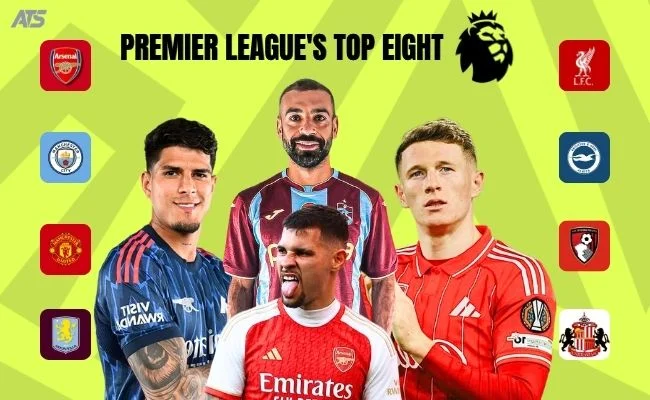
The eight clubs that finished highest in the Premier League last season all begin the 2026/27 campaign looking different to the sides that ended it. Three of them are under new management, and the transfer window stays open until 1 September.
Champions Arsenal, Manchester City, Manchester United, Aston Villa, Liverpool, Bournemouth, Sunderland and Brighton have all signed, sold and reshuffled their way through the summer. The published transfer lists suggest a great deal of change at almost every one of them.
Those lists are misleading, though, and in a fairly specific way.
The in-and-out columns mix three different things: players who genuinely arrived this summer, players who were already at the club and are only now being made permanent, and players who left months ago and are only now being processed on paper. Added together, they produce a number that says very little about whether a squad is actually stronger.
Arsenal are the clearest illustration. The champions spent £34.5m on Piero Hincapié, who had already played 39 games for them, started 20 in the league, and lined up in the Champions League final against Paris Saint-Germain.
He joined on loan from Bayer Leverkusen last September with a buy option attached, and according to ESPN, Arsenal simply activated it in late June. The transfer was new. The player was not.
So here is the same summer, sorted properly: every club in last season's top eight, according to the final table, and what genuinely changed at each of them.
Here is the short answer first, with the detail underneath.
Club | Where that leaves them | |
|---|---|---|
Arsenal | 🟢 | Stronger. Added Bruno Guimarães without losing a starter. |
Man Utd | 🟢 | Stronger, but incomplete. Two midfielders where they planned for three. |
Bournemouth | 🟢 | Stronger on paper. Around £54m spent with nobody of consequence sold. |
Brighton | 🟡 | Promising but younger. A record signing in, five experienced players out. |
Man City | 🟡 | Different, not clearly stronger. A record fee against a decade of leadership lost. |
Aston Villa | 🟡 | More depth, less creativity. Reinvested well, but Morgan Rogers is unreplaced. |
Sunderland | 🔴 | Riskier. Europe adds fixtures to a squad that has been trimmed, not expanded. |
Liverpool | 🔴 | Weaker for now. Three important players gone for no fee at all. |
Arsenal: 1st, 85 points
Champions for the first time since 2004, with David Raya keeping 19 clean sheets.
Strip out the paperwork and Arsenal's summer is smaller than it looks. Hincapié was already theirs, as above.
Jakub Kiwior's £14.7m move to Porto is the mirror image. He spent last season on loan there, and Porto activated their own option. Neither deal changes the squad by a single player.
What did change: Bruno Guimarães arrived from Newcastle, with Christos Tzolis joining from Club Brugge and Illan Meslier arriving from Leeds on a free transfer. Out went Leandro Trossard to Beşiktaş and Christian Nørgaard to Everton.
According to Sky Sports, the Guimarães deal was a flat £75m on a four-year contract. It takes Newcastle past £240m in player sales this summer.
Guimarães is the kind of signing champions rarely need to make. He captained Newcastle, and Arsenal grew confident of getting him only once Eddie Howe left.
Adding a midfielder of that standing to a side that just won the league is a statement of intent rather than a repair job.
The counter-argument is thinner than it sounds, but worth stating. Trossard and Nørgaard were useful squad players, and Arsenal face a season with the Champions League, a title defence and a longer domestic run to manage. Depth in wide areas is now less generous than it was.
Still, of the eight clubs here, Arsenal are the only one that has clearly added a first-team player of proven Premier League quality without losing one.
Manchester City: 2nd, 78 points
Pep Guardiola left Manchester City at the end of last season, after ten years in which he won six Premier League titles and, in 2023, the Champions League.
No manager has shaped an English club so completely in the modern era. Nothing else about City's summer makes sense without starting there.
The man replacing him is Enzo Maresca, and he knows the building. Maresca was on Guardiola's coaching staff during the treble season of 2022/23, then left to manage Leicester, whom he took back into the Premier League at the first attempt, before spending two years at Chelsea.
He now returns to a squad that someone else assembled, playing a style that everyone associates with someone else. He is expected to keep winning while he changes it.
His first piece of business was a record one. City signed Elliot Anderson from Nottingham Forest, and according to the Associated Press, the £116m fee beats the £100m they paid for Jack Grealish in 2021.
Anderson is 23, has signed a five-year contract, and played every match as England finished third at the World Cup.
The departures are the part worth pausing on. Bernardo Silva, after nine years at the club, left for Real Madrid on a free transfer when his contract expired. John Stones went the same way, joining Inter for no fee at all.
Manuel Akanji and Nathan Aké were both sold, and James Trafford moved to Leeds for £40m. Two of City's summer arrivals, Mathys Detourbet and Pierce Charles, were signed and immediately loaned out, so they count as accounting rather than reinforcement.
That is a lot of institutional memory leaving a dressing room in the same summer the manager did.
And it may not be finished. Rodri has entered the final year of his contract.
According to Sky Sports, City rejected a £40m offer from Barcelona on 7 August, and talks between the clubs have continued since. Nothing is agreed.
But if he goes, Anderson stops looking like an addition and starts looking like a replacement, and City's midfield rebuild becomes considerably less comfortable.
A £116m signing normally means a squad has grown stronger. At City this summer it is harder to be sure, because so much experience walked out of the door at the same time as the manager who knew how to use it.
Maresca may well decide the squad he inherited needed refreshing anyway, and he has been given the money to do it. For now, though, City look different rather than obviously better.
Manchester United: 3rd, 71 points
Two of United's headline moves this summer are not moves at all.
Rasmus Højlund's transfer to Napoli looks like a significant sale. According to ESPN, he had been in Naples on loan since last September, and the permanent element was worth around £38m.
He scored 16 goals in 44 games there. He was never going to be in Michael Carrick's squad.
André Onana is similar. Back from a season on loan at Trabzonspor, he has gone straight back to Trabzonspor. According to ESPN, his representatives were told in May that he was not part of Carrick's plans.
The reason is Senne Lammens, and he is worth a paragraph of his own. United signed the Belgian from Royal Antwerp on deadline day last September for around £18m, at a point when goalkeeping was the most heavily criticised part of the team.
He was 23, uncapped, and had never played outside Belgium. He then made 32 league appearances in his first season, kept eight clean sheets, made 79 saves, and prevented more goals than any other goalkeeper in the division.
According to Manchester United, he was voted Premier League Signing of the Season and is under contract at Old Trafford until 2030. Onana was never getting that shirt back.
There was also a signing that did not happen, and it is the reason United's summer still feels unfinished.
United moved for Atalanta's Éderson early, agreeing a fee of around £35m on 2 June, before the window had formally opened. The 27-year-old Brazil midfielder was the direct answer to Casemiro's departure, and with Manuel Ugarte facing a long lay-off, he was the most important piece of the rebuild rather than a luxury addition.
Then it unravelled in stages. Éderson was called up late to Brazil's World Cup squad after an injury to Wesley, which pushed the medical back.
Initial tests carried out in the United States during the tournament flagged an area of concern, and once Brazil went out in the last 16 he travelled to England for fuller examinations. According to Sky Sports, United then told Atalanta they would not proceed at the agreed price.
Atalanta disputed the reading. Sporting director Cristiano Giuntoli described the club as stunned, and they published footage of Éderson training as a public argument that his fitness was not in question.
They have since tied him to a new contract, which makes any revival of the deal considerably harder.
It is a defensible decision. A club that commits £35m and a long contract to a player it has doubts about tends to regret it.
But the effect is that United have added two midfielders where they had planned for three. With Casemiro gone and Ugarte injured, they are still shopping in the final weeks of the window.
What did land: Andrey Santos arrived from Chelsea for around £48m, Youri Tielemans came from Aston Villa for £35m after United triggered his release clause, and Marcus Rashford returned when Barcelona declined to make his loan permanent. Casemiro left on a free transfer, with Tyrell Malacia and Jadon Sancho released.
That is a proper midfield rebuild, and it is aimed at a specific problem. United finished third under an interim-turned-permanent manager while Bruno Fernandes carried an unusual share of the creative load, and two established midfielders plus a returning forward is a coherent answer.
Whether it is enough for a Champions League campaign is a different question, and one United will not be able to answer until the fixtures pile up.
Aston Villa: 4th, 65 points
On 20 May in Istanbul, Villa beat Freiburg 3-0 to win the Europa League. According to Sky Sports, it was a first trophy in 30 years and a first European title in 44, and Unai Emery's fifth win in the competition.
Youri Tielemans, Emiliano Buendía and Morgan Rogers scored the goals. By August, two of those three had been sold.
Rogers went to Chelsea for £117m, a British record. Tielemans went to Manchester United for £35m.
Lucas Digne, Donyell Malen and Enzo Barrenechea also left, and the loan players who lit up the run, Jadon Sancho among them, have gone back or moved on.
Villa did reinvest, and sensibly. Johan Manzambi arrived from Freiburg for around £51m, João Gomes from Wolves for £38m, and Alejandro Garnacho joined on loan from Chelsea.
That is real money spent on real players, at an age profile that suggests planning rather than panic.
The difficulty is what Rogers gave them that nobody else did. He was the player Villa's attacking play ran through, the one who made something happen when a game had gone flat, and he scored in the final that defined Emery's time at the club.
The £117m reflects all of that. What it does not do is turn back into chances created.
Manzambi and Gomes both make Villa stronger in the middle of the pitch, and both are young enough to become considerably more than they are now. Neither of them, though, does the specific job Rogers was doing.
Emery will have to find that creativity somewhere else in his squad, most likely from Buendía and Garnacho, and he will need to find it early.
Villa have more money and more squad than they did in May. Whether they have more of what made them good is the open question of their summer.
Liverpool: 5th, 60 points
Liverpool went into last season as champions and came out of it fifth, with 60 points and 12 defeats. Arne Slot left at the end of a campaign that never really got going.
The man who replaced him arrives with a serious reputation. Andoni Iraola had just taken Bournemouth to sixth, the highest finish in that club's history, built on an 18-match unbeaten run and a first ever European qualification.
Liverpool did not reach for a safe pair of hands. They went and took one of the most admired coaches in the division from a direct rival.
Then the departures started, and they were severe.
According to Sky Sports, Mohamed Salah's contract was terminated by mutual agreement a year early, after he was dropped and fell out publicly with Slot. He left on a free transfer and signed a two-year deal at Trabzonspor, closing a Liverpool career that brought 257 goals in 442 games.
Ibrahima Konaté went to Real Madrid the same way, for no fee at all, and Andy Robertson joined Tottenham on a free transfer of his own. Three players who had been central to the title win of 2025 left in the same summer, and Liverpool banked nothing for any of them.
Against that, the club has spent close to £90m on two young players. Jérémy Jacquet, a 20-year-old centre-back, arrived from Rennes for £55m. Víctor Muñoz, a 22-year-old forward, came from Osasuna for around £34.5m.
Ronald Araújo has also joined on loan from Barcelona, which at least gives Iraola an experienced defender to lean on while Jacquet settles.
The timing matters more than the money here. According to Liverpool's own announcement, the Jacquet deal was agreed early in the year, long before Salah, Konaté or Robertson had gone anywhere.
It was planning, in other words, rather than a response to losing them. Muñoz is the only signing made since Iraola took charge, and the head coach has already said in public that the squad needs more work before the window closes.
Some help is coming from inside the building. Harvey Elliott and Kostas Tsimikas both return to contention after being pushed to the margins under Slot, and a new manager will often get something out of players the previous one had stopped picking.
Even so, the arithmetic is hard to argue with. Liverpool have replaced three experienced players with two who are barely out of their teens, under a manager who is changing how the team plays.
On the current evidence they have gone backwards this summer, and Iraola's own comments suggest the club knows it.
Bournemouth: 6th, 57 points
The best season in the club's history, including an 18-match unbeaten run, and a first European qualification.
Then Liverpool took their manager.
Marco Rose replaces Iraola, and inherits a squad that has been added to rather than dismantled. Álvaro Rodríguez arrived from Elche, Antonio Silva from Benfica and Juanlu Sánchez from Sevilla.
According to Sports Mole, that is roughly £54m spent with no transfer income coming back the other way. In recent years Bournemouth have been a selling club. This summer they were not.
The notable loss is Marcos Senesi, who joined Tottenham on a free transfer when his contract ran out.
The squad, then, is stronger on paper. The uncertainty sits in the dugout.
Iraola spent three years building a distinctive way of playing at Bournemouth, and a new manager with different ideas takes over just as the fixture list gets longer than the club has ever handled. Rose has won titles at Salzburg and coached in the Champions League, so the appointment is not a gamble.
But continuity, which is what carried Bournemouth to sixth, is the one thing they could not keep.
Sunderland: 7th, 54 points
The most unusual window of the eight, by some distance.
Last summer, newly promoted Sunderland spent about £161m on 15 players, the biggest outlay ever recorded by a promoted club. It worked.
They finished seventh and qualified for the Europa League, only the second European campaign in the club's history.
This summer they have not paid a transfer fee at all. According to the Sunderland Echo, their only arrival is Thomas Meunier, who signed a two-year deal after his contract at Lille expired during the World Cup.
He is a more useful signing than the lack of a fee suggests. The 34-year-old right-back has over 550 senior appearances and 83 caps for Belgium behind him, with four-year spells at Paris Saint-Germain and Borussia Dortmund along the way.
He played 35 times for Lille last season as they finished third in France, scoring twice and setting up three more goals, and he has just come back from his third consecutive World Cup.
He has also played 43 Champions League matches and 33 in the Europa League. For a club returning to Europe after 53 years away, that is rather the point of signing him.
Meanwhile Eliezer Mayenda was sold to Rennes, Dan Neil left, and Lutsharel Geertruida's loan was not made permanent. Dennis Cirkin, Bertrand Traoré and Niall Huggins departed at the end of their contracts, though Granit Xhaka, the captain, has stayed.
Régis Le Bris has been explicit that this is deliberate. He wants a smaller, sharper squad, and has made the point that new signings do not by themselves make a team stronger.
He has also said more will arrive before the window shuts, targeting three or four core additions.
There is a real case for the approach. Sunderland's success last season came from a settled core, and clearing wages from the balance sheet matters under current spending rules.
But the arithmetic is unforgiving. A Europa League campaign adds at least eight fixtures to a squad that has been trimmed rather than expanded, in a division where the promoted teams have gone straight back down in each of the last two seasons.
Sunderland are no longer a promoted side, but they are asking a lot of the same players.
Brighton: 8th, 53 points
Brighton finished eighth, qualified for the Conference League, and then lost their best defender. What they did next is a fair summary of how the club operates.
Jan Paul van Hecke had made 131 appearances for Brighton and become Hürzeler's most trusted centre-back. Tottenham paid around £52m to take him.
Rather than spend that money on one like-for-like replacement, Brighton bought three defenders with three different profiles.
The expensive one is Luka Vušković, who came in the opposite direction from Tottenham. According to ESPN, the 19-year-old Croatia international signed a five-year deal, and at around £46m he becomes Brighton's record signing, passing the £40m they paid Leeds for Georginio Rutter in 2024.
He spent last season on loan at Hamburg, where he scored six goals in 30 Bundesliga matches from centre-back and was named the league's rookie of the season. Tottenham kept a 20 per cent sell-on clause, which tells you what they expect him to be worth later.
The other two are steadier. Pascal Struijk arrived from Leeds for around £18m with 119 Premier League appearances already behind him, and Michael Svoboda came from Venezia.
Further forward, according to Sports Mole, Brighton spent around £26m on Zadok Yohanna from AIK and £11m on Costinha from Olympiacos.
The exits go well beyond van Hecke, and this is where the character of the squad changes. Danny Welbeck joined Chelsea, Joel Veltman joined West Ham on a free transfer, and Diego Coppola was sold to Paris FC.
Solly March and Adam Webster were released, and James Milner retired. Evan Ferguson and Brajan Gruda return from loans.
This is Brighton doing what Brighton does, trading established players for younger ones at a profit and trusting the recruitment model. It has worked often enough to deserve the benefit of the doubt.
What is harder to replace is experience. Milner, Veltman, March, Webster and Welbeck between them held a lot of dressing-room knowledge, and Hürzeler now takes a notably younger group into a European season on top of the league.
What ties it together
According to Opta Analyst, nine of the twenty Premier League clubs changed manager this summer, the fastest the merry-go-round has spun in recent memory. The Premier League's own list confirms the scale of it.
Guardiola, Slot, Howe and Iraola have all moved on from clubs in this top eight alone.
That matters more than any individual fee. When the manager stays, a squad that loses two players can absorb it.
When the manager goes, everything is rebuilt at once: the ideas, the roles, the standards. The players who understood the old system suddenly become the most valuable thing in the building.
By that measure, Arsenal have had the cleanest summer. Same manager, a genuine upgrade in midfield, and a squad that otherwise stayed together.
Manchester United have addressed a specific weakness with two experienced midfielders and a returning forward, even if they wanted a third and did not get him.
Bournemouth are the most interesting of the three. They spent around £54m without selling anyone of consequence, which is not something they have often been in a position to do, and the squad Marco Rose inherits is deeper than the one that finished sixth.
Whether that survives the loss of the manager who built it is the question their season turns on.
Liverpool lost three important players for nothing and replaced them with two young ones under a new coach. Manchester City broke their transfer record while losing a decade's worth of leadership and a manager who defined the club.
Villa sold the man who created most of their chances. Sunderland are taking a seventh-placed squad into Europe with one free transfer added.
None of this is settled yet. There are three weeks of the window left, Rodri's future is still open, and Sunderland have promised more.
Ask again in September and one or two of these clubs will look different.
What is unlikely to change is the bigger picture. Take away the deals that were really done last year, and the players who never actually left, and most of these squads have moved far less than the headlines suggested.
In a summer when nearly half the league changed manager, that may end up mattering more than any of the money.